[ Zoom ]
|

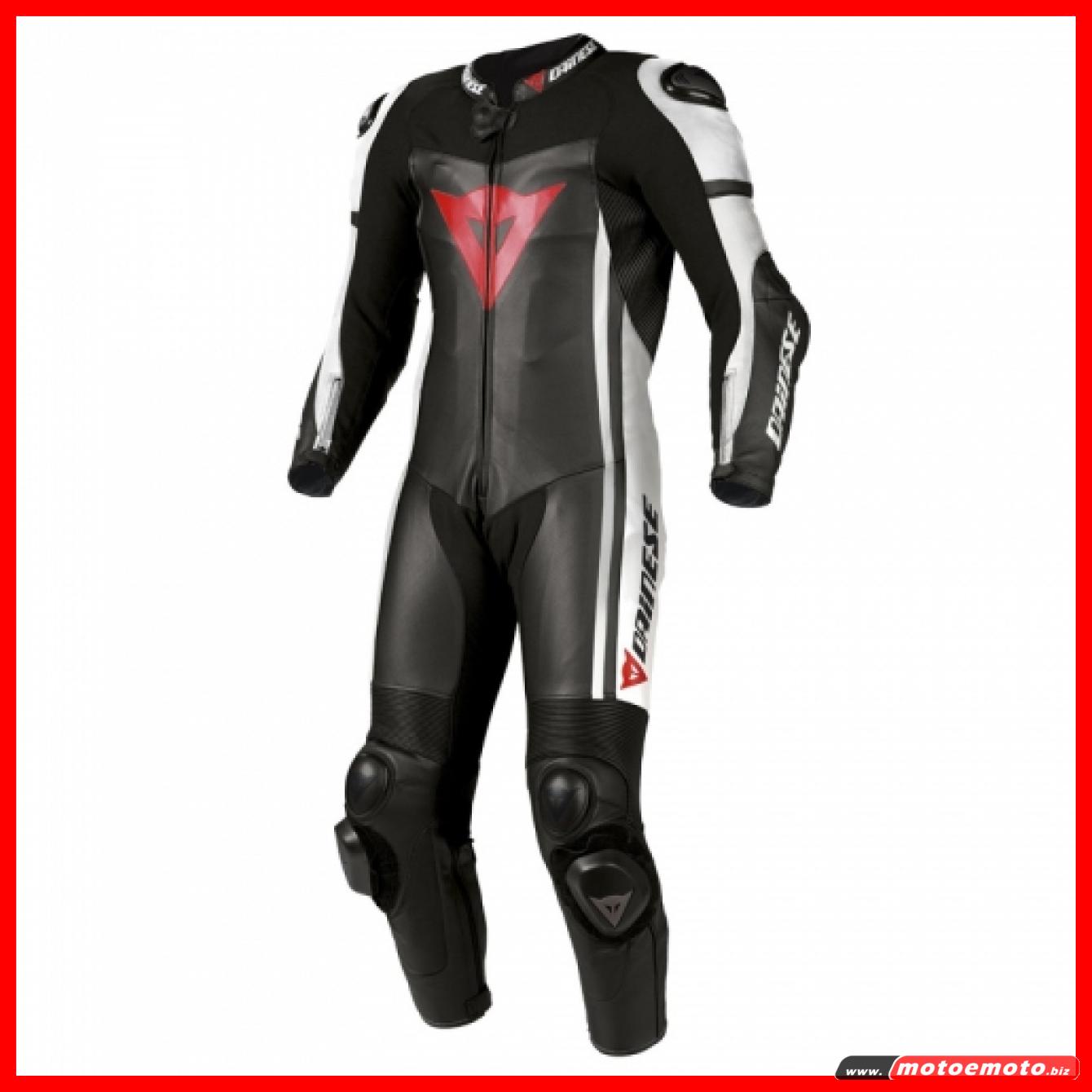
Dainese D-Air Racing Black Airbag Suit
 |  |  |
2.900,00 € | 110,00 € | 2.790,00 € |
|
|
|
|
Dainese is now making its D-Air airbag protection leather racing suit available to world riders. Utilizing a self-contained CPU stored inside the aerodynamic back hump of the leathers that employs three accelerometers, three gyros, and a GPS unit to determine whether an actual crash is taking place, the D-Air activates an inflation system that instantly (within 30 milliseconds) fills a four-liter-capacity airbag stored within the suit’s construction to protect the rider’s neck, shoulders, and collarbone, as well as reducing excessive helmet movement in a crash.
A sophisticated set of algorithms are programmed into the CPU that allows it to determine if a crash sequence is occurring, based upon the information from the five sensors. The most simplistic example is that the system will not arm itself unless the rider is traveling over 50kph (31 mph), thus the system will not deploy if, for instance, the rider is running down the pit lane and accidentally trips into a head-over-heels fall, or the suit falls to the ground from a shelf or hanger.
Dainese worked with F1/MotoGP telemetry company 2D to develop the sensor system, which also has software that allows the rider to download and plot telemetry data from the GPS sensor. The system has 2 GB of memory, and contains diagrams to permit assessment of acceleration and braking performance during a lap. The system is compatible with Google Earth, which allows the plotting of racing lines over a satellite map of the circuit (although the resolution in this case won’t be that detailed, due to the GPS antenna’s cycling rate and the location of the rider’s body in relation to the motorcycle during cornering).
The D-Air system uses a “cold gas” inflation system, which unlike conventional automobile airbag protection systems, uses no pyrotechnic triggers for the gas cylinders or a combination of heat and gas to inflate the airbag, which can quickly lose inflation as the gas cools. This permits the D-Air system to remain fully deployed for the duration of a crash, helping to protect the rider from injury. The system gradually loses inflation after 10 seconds, allowing the rider to get back into the race if he has not suffered injury and his bike isn’t damaged. The complete airbag system only adds 650 grams to the weight of the suit.
Dainese says that the D-Air system provides an 85-percent reduction in impact energy compared to conventional padded hard armor. The system has achieved the rigorous German TÜV SÜD certification, and Dainese claims that a separate new testing standard had to be created because the system far exceeded the previous standard levels. The company says that 10 years, 5000 test hours, and more than 100 actual crashes went into the development of the D-Air system, resulting in 13 different international patents.
|















































 News
News Search
 Cart (0)
 Reserved Area
 Spot
Spot
 Facebook

